“Discover why Huck bolt systems are replacing traditional fasteners in heavy industry. Learn about installation tools, vibration resistance, and how to choose a reliable distributor in India”.
The landscape of industrial fastening is undergoing a significant transformation. Engineers across sectors such as rail, mining, construction, and oil and gas are moving away from conventional threaded fasteners and welding in favor of more reliable, permanent solutions. At the forefront of this shift is the Huck bolt system, a technology that addresses the fundamental limitations of traditional fastening methods while delivering superior performance in demanding environments.
The Engineering Challenge with Conventional Fasteners
Traditional nuts and bolts rely on thread friction and torque to maintain clamping force. Under vibration, these fasteners gradually loosen. The result is joint failure, unplanned downtime, and costly maintenance programs that require regular retorquing. Welding, while permanent, introduces heat-affected zones, metallurgical changes, and inspection challenges that compromise long-term structural integrity.
Engineers have long sought a fastening solution that combines the permanence of welding with the simplicity of mechanical assembly. The Huck bolt system delivers exactly that.
How Huck Bolt Technology Works?
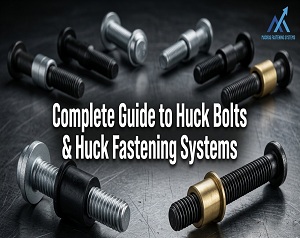
A Huck bolt consists of two components: a hardened steel pin with annular locking grooves and a ductile metal collar. During installation, the collar is swaged, into the grooves of the pin using specialized equipment. This creates a mechanical lock that does not rely on friction or tension to stay secure.
The engineering advantage is substantial. Unlike threaded fasteners, which have a 30% smaller cross-sectional area at the thread root, a Huck bolt maintains full cross-sectional strength throughout the joint. This allows for higher preload values, resulting in greater clamp force and superior vibration resistance. The joint remains tight for the life of the equipment, with no need for retorquing or periodic inspections.
The Critical Role of the Installation Tool
Proper installation requires a Huck bolt installation tool, which performs two simultaneous actions: it pulls the pin tight against the material and swages the collar into the locking grooves. The tool grips the pintail, generates the required clamp force, and breaks the pintail off at the precise tension point. Operators receive an immediate visual signal when installation is complete, eliminating guesswork and the need for torque wrenches.
Modern tools are available in hydraulic, pneumatic, and battery-powered configurations, making them suitable for both high-volume production lines and field applications in confined spaces. The installation cycle takes only seconds, offering up to 40% time savings compared to traditional bolting methods.
Superior Performance in Demanding Applications
Industries that operate under extreme conditions have been quick to adopt Huck lockbolts. Rail wagon manufacturing, metro coach assembly, mining trucks, and oil and gas infrastructure all benefit from these fasteners’ exceptional vibration resistance and fatigue strength. The permanent nature of the joint eliminates maintenance-related safety risks.
The fatigue life of a Huck lockbolt is up to ten times greater than that of conventional nuts and bolts. This translates directly into extended equipment service life and reduced lifecycle costs. Engineers designing critical structures, from steel bridges to heavy defense vehicles, specify these fasteners for their proven reliability in safety-critical applications.
Choosing the Right Partner
Selecting the appropriate fastener and tooling requires technical expertise. Understanding how to choose a Huck bolt distributor is essential for ensuring product authenticity and application success. An authorized distributor provides factory-trained support, genuine products, and guidance on proper tooling selection. Working with a reliable Huck bolt distributor in India ensures access to the complete product range and technical assistance for optimal joint design.
The Shift toward Permanent Fastening
The trend is clear: engineers are choosing Huck bolt systems for their combination of installation speed, vibration resistance, and maintenance-free performance. As industries demand higher reliability and lower total cost of ownership, this technology is becoming the standard for structural fastening in heavy-duty applications.
For engineering professionals seeking fastening solutions that eliminate loosening, reduce maintenance costs, and improve structural integrity, Huck bolt systems represent the future of industrial joining.
Conclusion
Choosing Huck bolt technology means prioritizing long-term reliability over short-term convenience. These systems eliminate loosening, reduce downtime, cut maintenance costs, and enhance safety, all while speeding up installation.
For engineers designing critical infrastructure and heavy machinery, the advantages are undeniable. Partnering with a trusted name like Macros Fastening ensures access to genuine fasteners and expert technical support.
As operational demands intensify, permanent mechanical fastening is no longer just a trend, it is an engineering necessity for decades of structural integrity.