“Learn how Huck bolts handle vibration and fatigue, why their joint design supports long-term reliability, and where they fit in demanding industrial applications”.
A fastening joint may look secure when it is first assembled. However, its real test begins once the equipment starts working. Heavy machinery vibrates. Vehicles move over uneven roads. Structures experience changing loads. Over time, these repeated forces can affect the joint.
This is where the choice of fastening method becomes important.
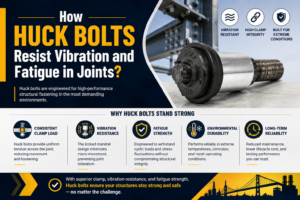
A Huck Bolt uses a pin and collar instead of the traditional bolt and nut arrangement. During installation, the collar is swaged onto the pin. This creates a controlled clamp force across the joint. The result is a permanent connection that is designed to resist loosening under vibration.
Why Does Vibration Affect Fastened Joints?
Vibration creates repeated movement between joined parts. Even small movements can become a problem when they happen thousands of times.
With a traditional threaded fastener, the joint depends on the correct preload to stay tight. If that preload falls, movement can increase. In severe conditions, the nut may gradually loosen.
Lockbolt systems approach the problem differently. The collar is mechanically locked onto the pin during installation. There is no conventional nut that can rotate loose. This makes the fastening method useful in applications where vibration is part of normal operation.
The joint still needs to be designed correctly, of course. Fastener selection, hole quality, material thickness, and installation all affect performance.
What Role Does Fatigue Play?
Fatigue is not the same as one large impact. It happens when a component experiences repeated loading over time.
Think about a truck travelling thousands of kilometres. Its frame and body are exposed to continuous movement. The same principle applies to railway vehicles, construction equipment, and industrial machinery.
A fastening joint in these environments has to cope with repeated stress without losing its ability to hold the parts together.
The clamp created during installation is important here. A properly installed lockbolt keeps the joined materials under compression. This can help limit unwanted movement between the parts and support the overall fatigue performance of the joint.
That does not mean a fastener can prevent fatigue failure in every situation. The entire joint design matters. Engineers must consider the material, load pattern, hole design, edge distance, and expected service conditions.
Why Do Engineers Consider Lockbolts?
There is a practical reason Structural Engineers Prefer Huck Bolts Over Threaded Fasteners in certain applications. Lockbolts can provide consistent installation and strong resistance to loosening, which can be useful in structures exposed to vibration and repeated loading.
Installation consistency is another point worth considering. A conventional threaded fastener often relies on achieving the correct torque. Several factors can influence the actual preload, including friction between the threads and under the nut.
A lockbolt is installed through a controlled swaging process instead. The collar is formed onto the pin, creating the finished joint.
This can make the installation process more repeatable, particularly when many fasteners need to be installed across a large assembly.
What About Hard-to-Reach Joints?
Not every fastening point is easy to access. Sometimes there is no practical way for an operator to reach the rear side of a joint.
This is where Huck Blind Fasteners can be useful. They are designed for installation from one side, which makes them suitable for enclosed sections, hollow structures, panels, and other areas where access is limited.
The important point is that blind fasteners are not simply chosen because they are convenient. Their load requirements, grip range, material, and application conditions still need to be checked.
Where Are Vibration-Resistant Fasteners Used?
The applications are quite varied.
Heavy trucks and trailers experience constant movement on the road. Railway equipment faces repeated vibration as vehicles travel over tracks. Mining machinery operates under demanding loads and rough conditions. Steel structures may also experience changing loads, wind forces, or equipment-induced vibration.
In these environments, a joint that stays secure over time can reduce maintenance concerns and support reliable operation.
The right installation tool matters as well. The tool must match the fastener and should deliver the required force during installation. Poor installation can affect even a well-designed fastening system.
Choosing the Right Fastening Solution
A Huck Bolt Distributor in India can be useful when technical guidance is needed alongside product selection. However, the final choice should always begin with the application.
Engineers should look at the expected loads, vibration levels, fatigue conditions, joint materials, access, and installation method. The fastener should then be selected according to these requirements.
A strong fastening joint is not created by the fastener alone. Joint design, material selection, hole preparation, tooling, and installation all play a part.
That is why vibration resistance should be considered at the design stage, rather than after a joint begins to loosen. When the fastening method matches the working conditions, the connection has a better chance of remaining reliable throughout its service life.