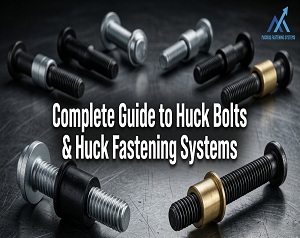
“Learn how to select Huck Lockbolts for high-cycle industrial joints by reviewing loads, joint design, grip range, vibration, access and installation needs”.
Industrial joints in rail vehicles, heavy equipment, trailers and structural assemblies can experience repeated load cycles throughout service. Continuous movement, vibration and changing forces can place long-term stress on a fastening system. Huck Lockbolts can be considered for these applications because their pin-and-collar design creates a mechanically locked joint. The correct selection, however, still depends on the joint itself.
How Huck Lockbolts Suit High-Cycle Joints?
High-cycle joints are exposed to repeated loading rather than a single static force. They may see vibration, alternating loads, shock or movement between connected components. In these conditions, maintaining clamp and limiting unwanted joint movement become important design considerations.
A lockbolt uses a pin and collar joined through a swaging process. This differs from a conventional threaded fastener, where installation depends on tightening a nut to establish preload. The method can therefore offer repeatable installation when the fastener, hole, material stack and tooling are correctly matched.
Engineers should review expected shear and tensile loads, material thickness, hole geometry and service environment before selecting a fastener.
Review Grip Range and Joint Materials
Grip range is the combined thickness of the materials being fastened. The selected fastener must suit the actual material stack, including normal manufacturing tolerances.
A joint made from structural steel may have different requirements from one joining thinner sections or mixed materials. Hole size, edge distance and alignment should also be checked before the fastener is specified.
The aim is to select a fastener that works with the complete joint design. An unsuitable grip range or poor hole condition can affect the finished connection even when installation is carried out correctly.
When BobTail May Be the Better Option?
Huck Bobtail Lock Bolts are part of the broader lockbolt family and use a pintail-less design. This can be useful where installation efficiency, reduced installation debris and a clean finished joint are important.
Their suitability still depends on the application. Engineers should review diameter, grip range, material, expected loading and available installation space before choosing a BobTail system.
For high-cycle assemblies, the selected fastener family should match the mechanical requirements of the design rather than being treated as a universal solution.
Consider Access Before Finalizing the Fastener
Joint access can change the fastening decision. A two-piece lockbolt requires enough space to position the pin, collar and installation tool correctly.
Where the rear side cannot be reached, Huck Blind Fasteners may be more appropriate because they are designed for one-sided installation. The choice between a lockbolt and a blind fastener should therefore begin with access and then move to load, grip and material requirements.
Tool clearance should also be checked early. Tight corners, enclosed frames and nearby components can make installation difficult even when a fastener is mechanically suitable.
Match the Fastener With the Installation Tool
The installation tool and nose assembly are part of the fastening system. They must match the fastener family and diameter and provide sufficient access to the joint.
Huck Bobtail Lock Bolts require tooling designed for their installation method. Production volume, operator access, tool weight and available power source can influence whether hydraulic, pneudraulic or battery-powered equipment is more practical.
Tool selection should therefore happen alongside fastener selection. This helps prevent a situation where the chosen fastener meets the engineering requirement but cannot be installed consistently in the available space.
Compare the Complete Joint, Not Just the Fastener
The Advantages of Huck Bolts Over Traditional Bolts are most meaningful when the comparison considers the entire joint. Installation method, clamp consistency, vibration exposure, inspection requirements and long-term maintenance should all be part of the evaluation.
For high-cycle applications, engineers should also consider how the joint will be manufactured and inspected. Hole preparation, material variation and operator access can influence installation consistency across a large assembly.
Select for the Application
There is no single fastener for every repeated-load joint. The correct choice comes from reviewing load pattern, grip range, materials, hole condition, vibration, access and tooling together.
Huck Lockbolts can provide a practical option for demanding industrial assemblies when correctly matched to the joint and installed with compatible tooling. Treating the fastener, tool and joint design as one system gives engineers a stronger basis for selecting a fastening method for high-cycle service.